Mutsuhito Meiji – 明治天皇 – (1852-1912), 122nd Emperor of Japan (and grandfather of Hirohito), announced at the beginning of his reign that “the customs of ancient times are abolished forever”, thus bringing Japan into modernity. Meiji opened his country, which had been closed to outside influences until then, created a constitution, an elected parliament, abolished castes, distributed land to peasants, made education compulsory and sent the best students to Western universities.
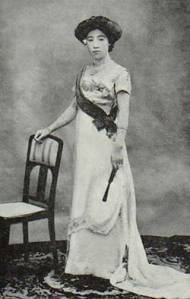
On January 11, 1867, Mutsuhito Meiji was only 15 years old when he married Lady Haruko. She would not give him any children. But that did not matter, at the time, there were also concubines designated as “official ladies”. He will have several who will give him 15 children. Only 5 of them will reach adulthood, a boy, Yoshihito – 大正天皇 who will succeed him and four daughters, imperial princesses. It is one of them that we are talking about here, 12th child and 8th daughter of Meiji, Princess Fumi-no-miya Nobuko (1891-1933), daughter of Emperor.
On May 6, 1909, Princess Nobuko married Prince Yasuhiko Asaka and, in doing so, became Her Imperial Highness Princess Fumi Nobuko. Her husband graduated from the Imperial Army Academy and reached the rank of lieutenant colonel. In 1922, he embarked for France to perfect his skills in the art of war at the Ecole Spéciale Militaire de St-Cyr, under the name of “Count Asa”. He took advantage of this stay to make private study trips to Europe with a couple of cousins, Prince Naruhisa and his wife Princess Fusako. North of Paris, a serious car accident killed the driver and the prince cousin, seriously injured the princess and Asaka who, hit in the legs, was paralyzed.
Upon learning of the tragedy, Princess Nobuko rushed to France to support her husband in his long convalescence. They stayed there for two years and toured Europe together. In 1925, on the eve of their return to Japan, they visited the International Exhibition of Modern Decorative and Industrial Arts, the first exhibition entirely devoted to decorative arts, from which the term “Art Deco” was derived. They came away fascinated.
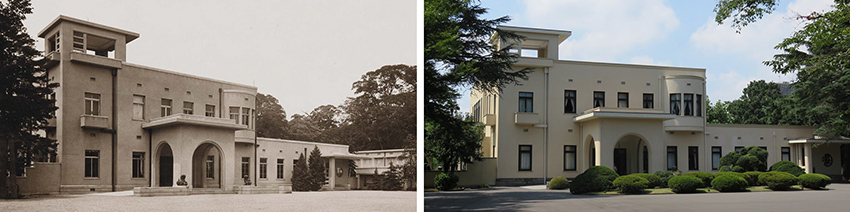
The Villa Teien, built in 1933, still in its original splendor today.
Back in Tokyo, the couple found their house devastated by the great earthquake that ravaged the city in 23. Princess Nobuko contacted two designers who had been introduced to her at the Paris fair, Henri Rapin and René Lalique. She asked them to design the interior of their new residence under construction, with the mission of introducing Art Deco to Japan. The large and splendid house would not be completed until April 1933. Unfortunately, Princess Nobuko would not be able to enjoy this exceptional residence of which she was the instigator for long because she suddenly fell ill and died six months later, on November 3, 1933.
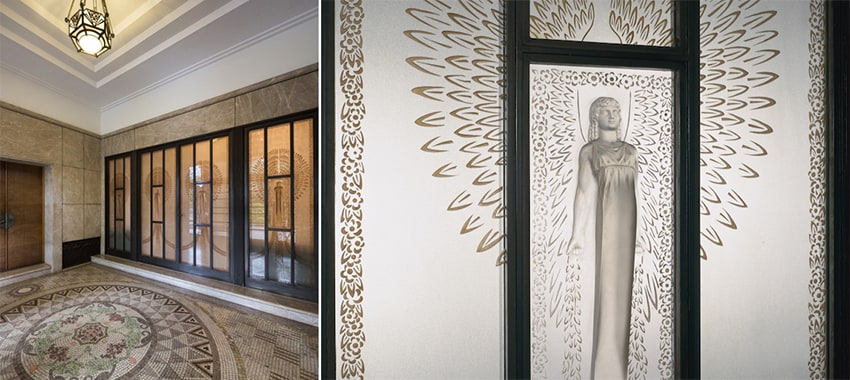
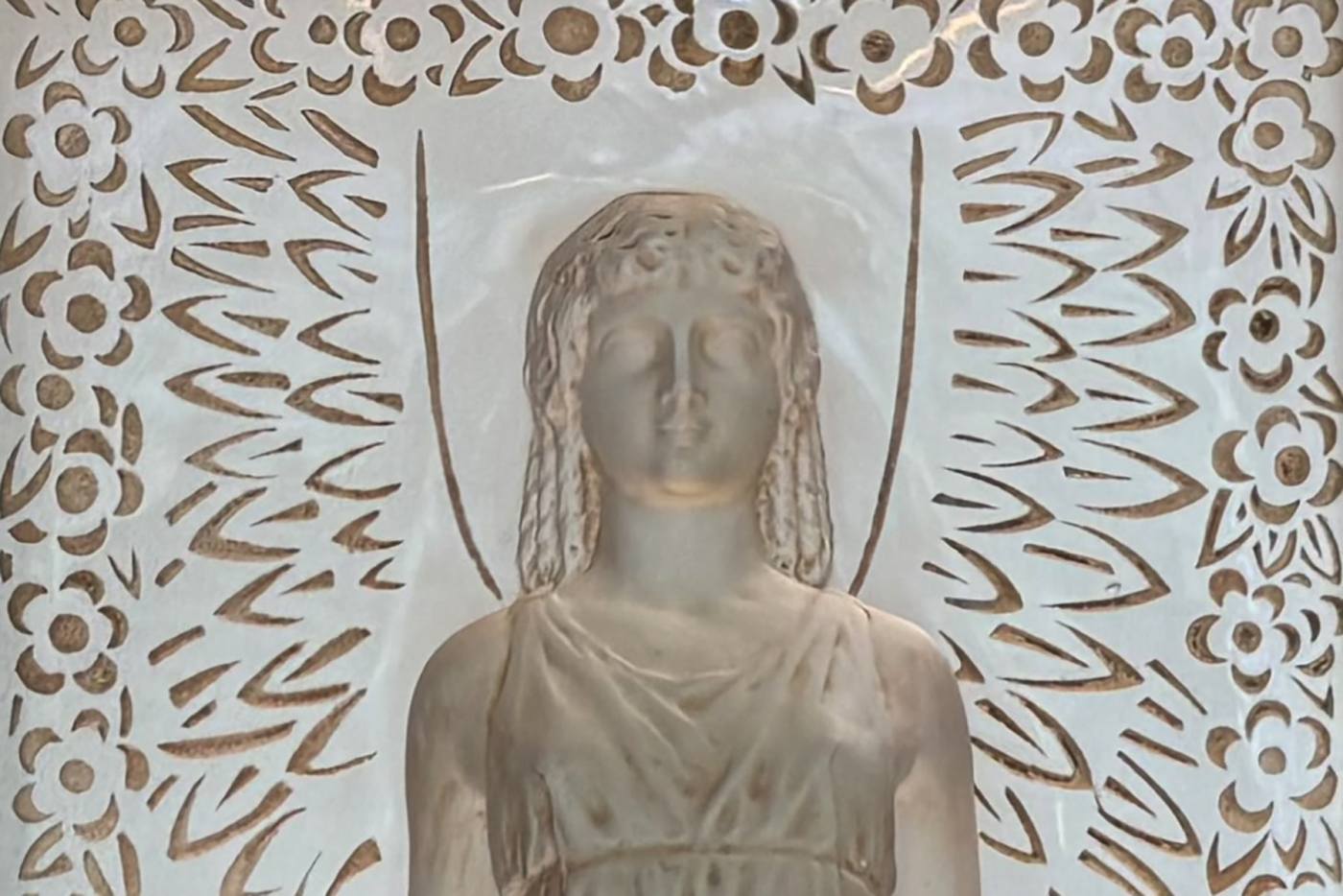
Four silhouettes of goddesses emerge from the panels signed Lalique, as if to welcome the guests. The mosaic is made of natural stone, the work of Takashi Oga of the Construction Bureau of the Imperial Household Agency.
If the idea for this residence originated from the Art Deco exhibition of 1925, it was in 29 that the work began. But in 31, Japan invaded Manchuria and the military prince had other concerns and duties than the decoration of his future home. In 37, the war with China and Russia sent Prince Asaka to Shanghai where he would not have had clean hands. In 45 Japan capitulated and Asaka, like all the Japanese nobility, was stripped of all his titles.
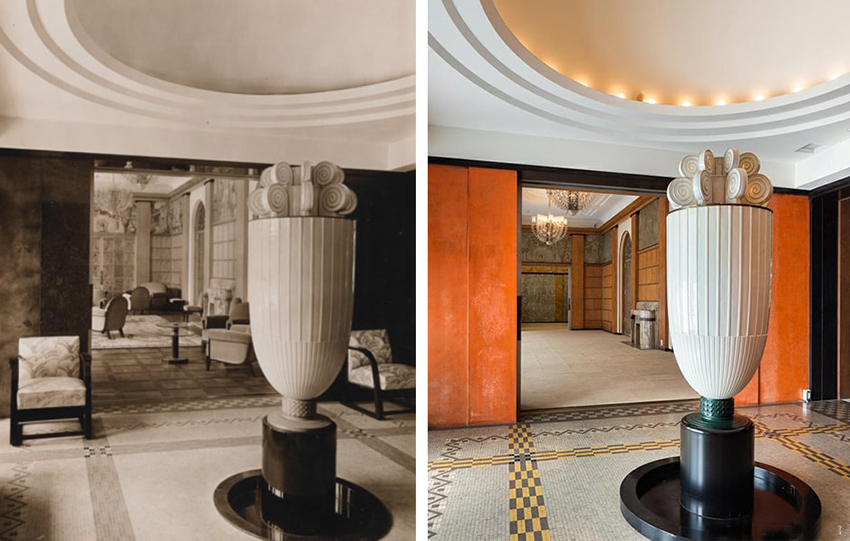
The “perfume tower”, a fountain created by Henri Rapin, manufactured at the Manufacture Nationale de Porcelaine de Sèvres diffused pleasant perfumes throughout the room.
His Art Deco palace was seized by the new government and served, from 1947, as the residence of the Prime Minister, Shigeru Yoshida. Then from 55 to 74, it became the official residence of distinguished guests visiting Tokyo. It was not until 1981 that the title of ownership was transferred to the city government, which opened it to the public on October 1, 1983, as the Tokyo Metropolitan Teien Art Museum. In 2015, what had been the residence of Prince and Princess Asaka was given the status of “Important Cultural Property” for its inestimable artistic value.
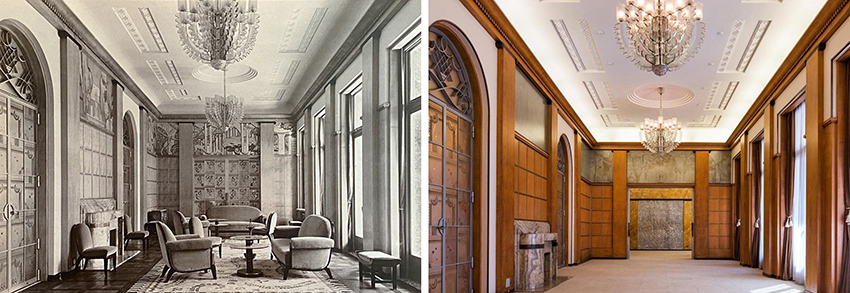
The Grand Salon, Yesterday and Today.
If the exterior architecture is relatively simple, it is the interior design that makes this Art Deco residence exceptional. The Asaka couple of course had unlimited financial means, but above all they had an extraordinary artistic sensibility.
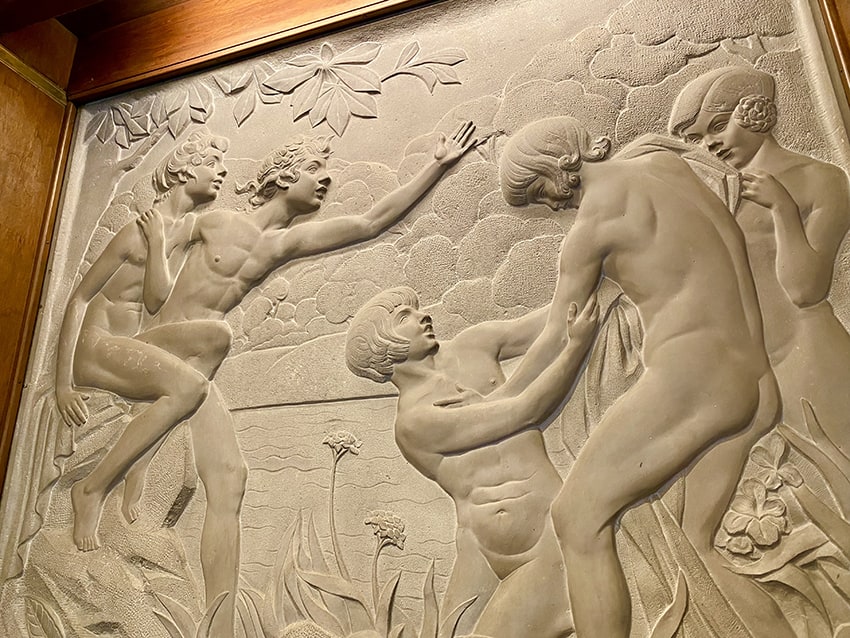
In the great hall, this marble bas-relief is the work of the French sculptor Ivan-Léon Blanchot.
Both knew how to choose and inspire the greatest French and Japanese decorative artists of the time. Henri Rapin, who designed and decorated seven rooms of this residence including the iconic entrance hall and its sublime Perfume Tower, René Lalique, jeweler and world-renowned master glassmaker who was responsible for the light fixtures and glass in the entrance doors, Alexandre Blanchot, sculptor of the “Playing children”, marble placed in the great hall, Max Ingrand, painter and glass artist, who created the stained glass windows and doors decorated in frosted glass in the living room and dining room and Raymond Subes, artistic ironworker to whom we owe the splendid decorations of the tympanums of the doors. The mosaics, wallpapers, and wall decorations were designed by Japanese artists, including Takashi Oga, from the Construction Bureau of the Imperial Household Agency. A perfect symbiosis between French creativity and Japanese sensitivity.
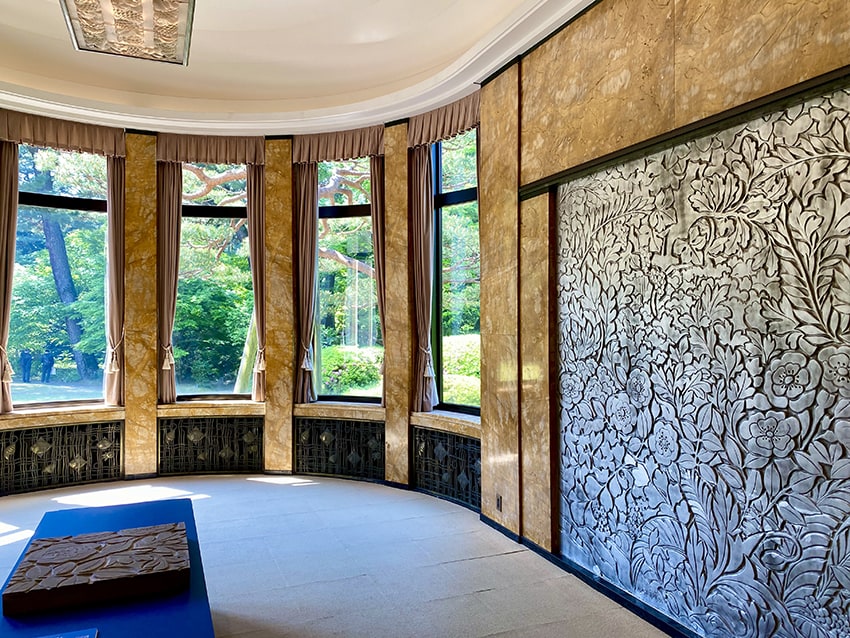
In the large dining room, flower and fruit motifs were predominantly used, including in the glass ceiling lights “Ananas et Grenades” designed by René Lalique and on the doors by Max Ingrand with its fruit motifs. The radiator covers are decorated with fish and shellfish.
The Villa Teien seems a very surprising residence with its pure Art Deco style in the middle of ultra-modern Tokyo. Also a survivor, it escaped the terribly destructive American bombings of the spring of 45 and the frequent earthquakes including that of March 11, 2011, the most violent ever recorded in Japan.
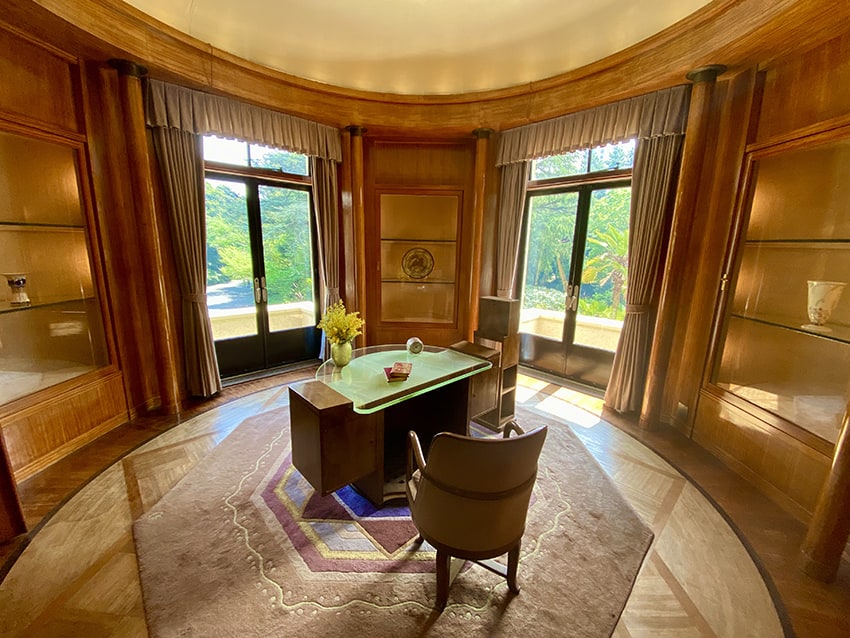
Yoshida Shigeru, who, after the war, was both Minister of Foreign Affairs and Prime Minister, decided to live here rather than in the Prime Minister’s residence. He used this room, designed and decorated by Henri Rapin, as an office.
Also remarkable, the Villa Teien has remained unchanged in its architecture and interior decoration as well as in its furniture. Everything or almost everything has been kept, preserved, maintained, respected.
Rare – and this is worth noting – are the sublime private residences that resist time, the elements, the appetites of developers, fashions, inheritances, vandals… as the Villa Empain – Boghossian Foundation- in Brussels (Belgium) and the Villa Cavrois in Roubaix (France) suffered, which had to be restored at great expense.
Today we can wander around this Villa-museum Teien as the Asaka couple did, to realize their great artistic sensitivity and also thank the wealthy people for leaving us such sublime residences as a legacy.
Brigitte & Jean Jacques Evrard
 ADMIRABLE ARCHITECTURE - BLOG
Leave a comment