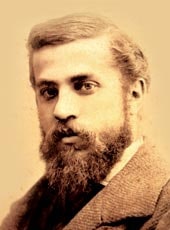
“We have awarded the diploma to a madman or a genius. Time will tell.” This is what Mr. Elies Rogent, director of the brand new Provincial School of Architecture of Barcelona, said in 1878 when he handed over his diploma to Antonio Gaudí. Upon receiving this precious document, Gaudí said to his friend the sculptor Llorenç Matamala: “Llorenç, it seems that now I am an architect!”
This is a summary of the early career of the man who is undoubtedly the most brilliant architect of the modern era, the very first to have rethought architecture that had been classical until then. Influenced by his readings on oriental art (Persia, India, Japan), by the Islamic buildings of Spain and of course by the Gothic architecture that was reborn at the end of the 19th century theorized by Viollet-le-Duc, Gaudí quickly began to consider architecture differently. Because therein lies the genius of this young architect. Through his intuitive knowledge of architecture, he observes, analyzes, understands, imagines, creates. He is one of those, extremely rare, who can reinvent instinctively, without having to be initiated by a master, being master before the master. Without need, neither for recognition, nor for students, nor for disciples, nor for sharing. Pure genius, mystical, almost inaccessible to others.
Gaudí found that Gothic architecture was open to criticism, and that he therefore had to perfect it. He said of it: “Gothic art is imperfect; it is only halfway to the solution; it is the style of the compass, of the formula of industrial repetition. Its stability is based on the permanent support by the buttresses; it is a defective body that supports itself by crutches”. Absolute clairvoyance.
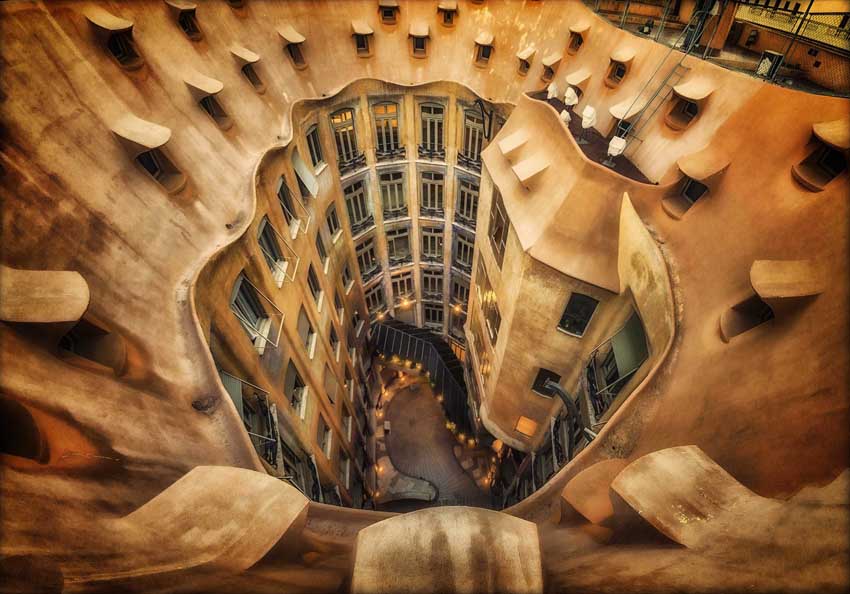
Interior courtyard of Casa Mila (La Pedrera) – Photo: Massimo Cuomo
Towards the end of the 19th century, Art Nouveau was in full swing and Gaudí made it his own by transcending it. It was during this period that his genius was deployed and that which had been dormant in him since his early childhood was expressed in a wonderful way. Because in his maturity Gaudí thought of architecture as nature is made. We see this in his most remarkable works, today considered marvels throughout the world, Casa Batlló, Casa Milà (Pedrerra), Park Güell and of course the pinnacle, the Sagrada Família, which are the pride of Barcelona.

Gaudí being very religious, even mystical, it seems normal that he looked at nature, the work of God, or rather God himself, as a source of inspiration, admiration, wonder and respect. By analyzing the architecture of these four most admirable achievements, we see that everything is thought of as nature and organic life are. The liquid, with the roofs with tiles made of batrachian scales, the ceilings imitating the sea swell, the decorations in the shape of octopus, conch, algae, starfish… The mineral, with the cut stones, sculpted as if by the wind and water… The air with colored stained glass windows, skylights, illuminated interior courtyards… The plant with the trees, leaves, flowers, fruits…
The animal with the shimmering representations of animals, birds, reptiles, fish, insects of all types. There are even representations of tadpoles… or spermatozoa, germs of life, perhaps?
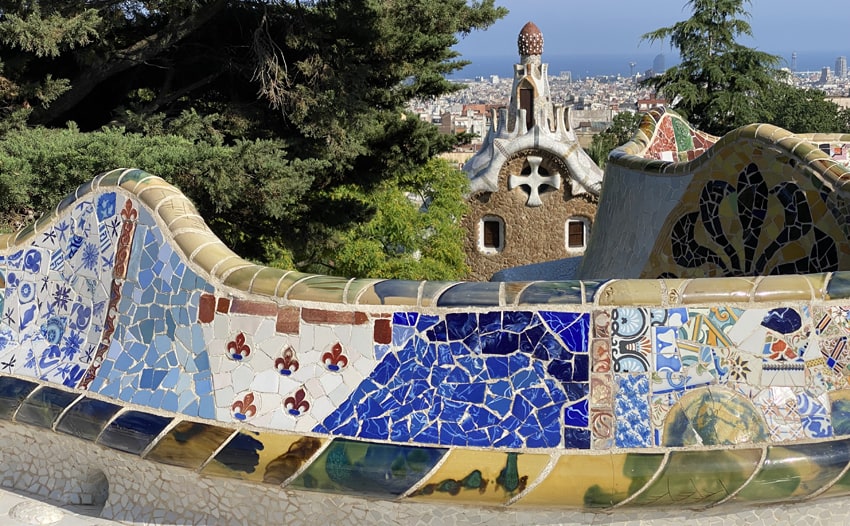
A pioneer, he was also in the choice of materials, an ecologist well before his time. He uses trencadis, mosaics made from ceramic manufacturing waste, to decorate flat and curved surfaces. The result of these patchworks is surprising, fascinating, colorful and extremely resistant. We can admire the effects on the undulating benches of Park Güell.
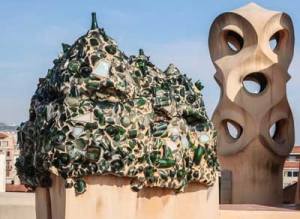
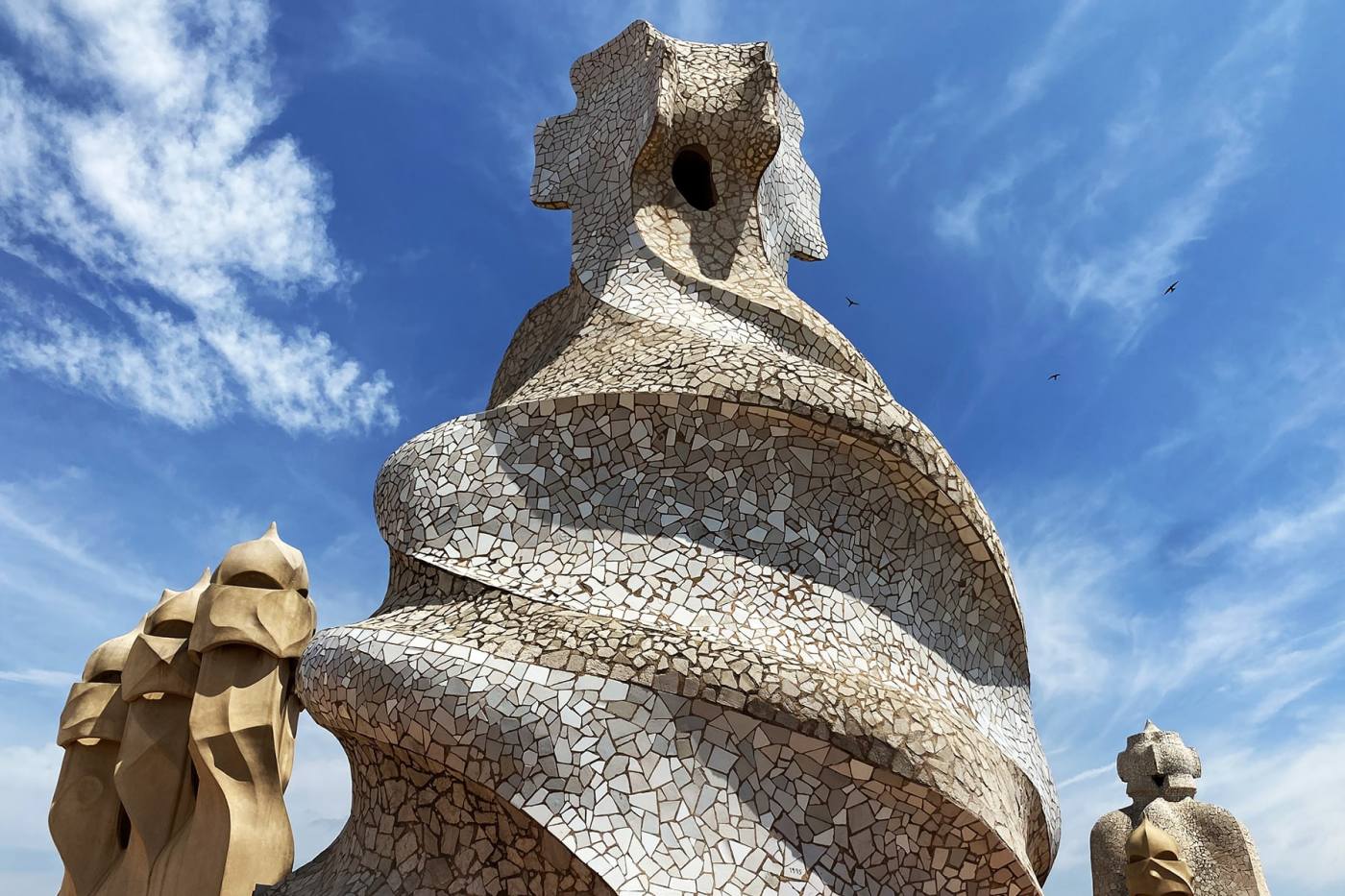
For one of the chimneys of Casa Milà, Gaudí used simple broken bottles at a time when the word recycling did not yet exist.
But it is in the invisible to the common that Gaudí’s genius is most remarkable. In the forms he gives to his constructions, to interior spaces, to decorations. He uses the forces of nature and organic structures to model his architectures. He uses forms that were previously unseen, such as the hyperbolic paraboloid, the hyperboloid, the helicoid and the conoid. Very learned terms reserved for specialists (Wikipedia should enlighten you).

Gaudí introduces in profusion a specific form, called the chain or catenary, a flat curve that a rope suspended by its ends takes, naturally, by its own weight and gravity, a bit like a long pearl necklace would do around a beauty’s neck.
His creations are asymmetrical, undulating, innovative. He will devote his life to the search for optimal solutions, in volumes, forms and assemblies. Preferring the plaster model, the removed sketch to the drawn plan, sculpting or drawing thus with his hands, his major works.
There is so much to say about this genius, so much has already been written, in detail, by scholars, historians, architects. And more will be written. Much better than this simple text only intended to encourage you to go see, or see again, these 4 wonders. Gaudí’s work is major, infinite and eternal.
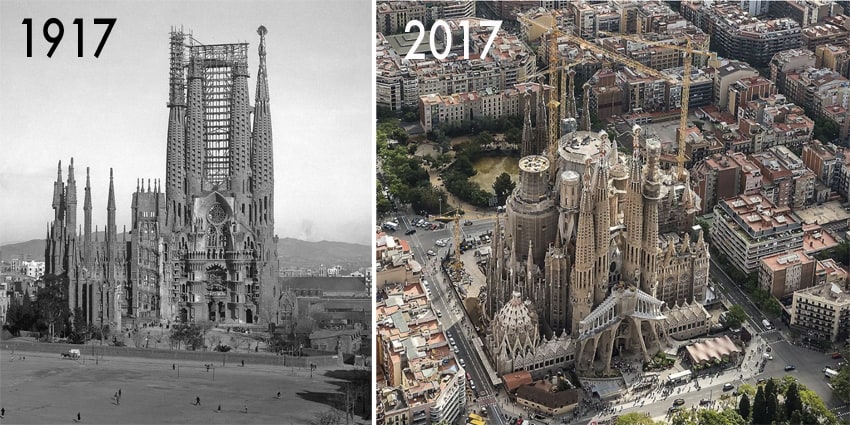
As proof, the Sagrada Familia, undertaken by him from 1883 and under construction until his death in 1926, at that time unfinished. Still unfinished today, this masterful construction must be the only one in the world to continue, to be completed, almost a century after the death of its creator, by other architects, engineers, craftsmen, artists in the very particular spirit of Gaudí. Knowing that he would never see the Sagrada Familia completed in his lifetime, he made sure to build enough elements in shapes, styles and heights to force his successors to continue and complete his work as he would have done. A brilliant architect to the end.
ANECDOTE…
It seems that where the Twin Towers stood in New York, built in 1972 by architect Minoru Yamasaki and destroyed during the September 11, 2001, attacks, the Hotel Attraction was to be built at the very beginning of the 20th century. More than a hotel, the project included restaurants, leisure areas, performance halls, museums, shops and apartments. The main tower was to culminate at 360 meters, thus becoming the tallest building ever built in the world.

This project, initiated in 1908, took 3 years to design and would have taken 8 years to build. A project that was far too ambitious and required an excessive investment. Having too much work, the architect chosen by the American investors, declared forfeit in 1911, because he preferred to devote himself to his major work, the Sagrada Familia. Too bad, we could have admired in the USA, the only work of Gaudí outside Spain.
It should also be noted that, when the project of reconstruction of the destroyed World Trade Center was launched immediately after the attacks, a group formed of engineers and architects, admirers of Gaudí’s work, proposed to take over the project of Hotel Attraction on the basis of the sketches of Gaudí found by chance long after the death of the architect. Despite many positive arguments and support, it is the project of Daniel Libeskind that was chosen. Otherwise, New York would have had a symbol all in curves, in colors, in elegance, feminine! Missed opportunity.
Photo Antonio Gaudi: Pau Audouard.
Brigitte & Jean Jacques Evrard
 ADMIRABLE ARCHITECTURE - BLOG
Leave a comment