
Kishichiro Okura (1882-1963), the only son and heir of a prominent entrepreneur, studied at Cambridge and returned to Japan steeped in Western culture. A shrewd and visionary businessman, he dreamed of building a luxury hotel that would bring the two cultures together.
In May 1962, the Hotel Okura, designed by architect Yoshiro Taniguchi, opened in Tokyo’s Toranomon district. The Okura lived up to its promise, a superb representation of the modernist style, demonstrating that Japan had recovered from the cruel devastation of war and, with the approaching Olympic Games, was entering a new era of modernity, growth, and peace.
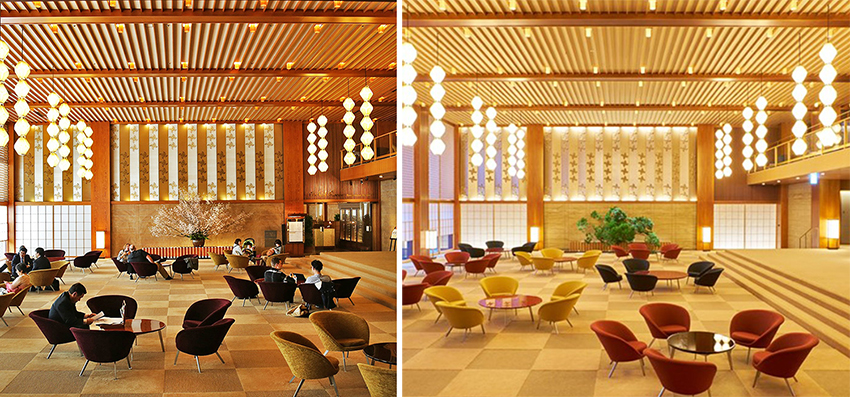 Hexagonal lanterns hung like pearls from the ceiling. The afternoon sun filtered through wooden trellises and paper screens. Modernist armchairs surrounded lacquered tables like the petals of a plum blossom. Today, Tokyo’s most famous (and most mourned) lobby has been brought back to life. Almost nothing has changed between the old and new Okura.
Mr. Okura appointed Iwajiro Noda, a businessman with no experience in hotel management, as head of his hotel. He was one of the few of his time to engage in international trade and, in doing so, to stay in the finest hotels around the world. This experience was invaluable to him, both in establishing the rules of reception, organization, and service, as well as in the design of the shared spaces and rooms. It was he who also proposed the name Hotel Okura and suggested favoring the design of the Heian period, the most refined of the 14 periods that make up Japan’s history. The aim was to make this new hotel a complete and unique work of art, a must-see for the greatest political and artistic figures.
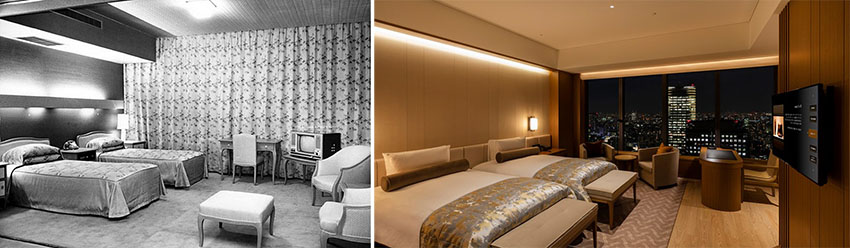 The rooms were in dire need of a makeover.
The lobby, the large lounges, the mezzanine, the lighting, the bar, the corridors, and the rooms were designed with the greatest care, crafted using traditional techniques by the finest craftsmen, using the most remarkable materials.
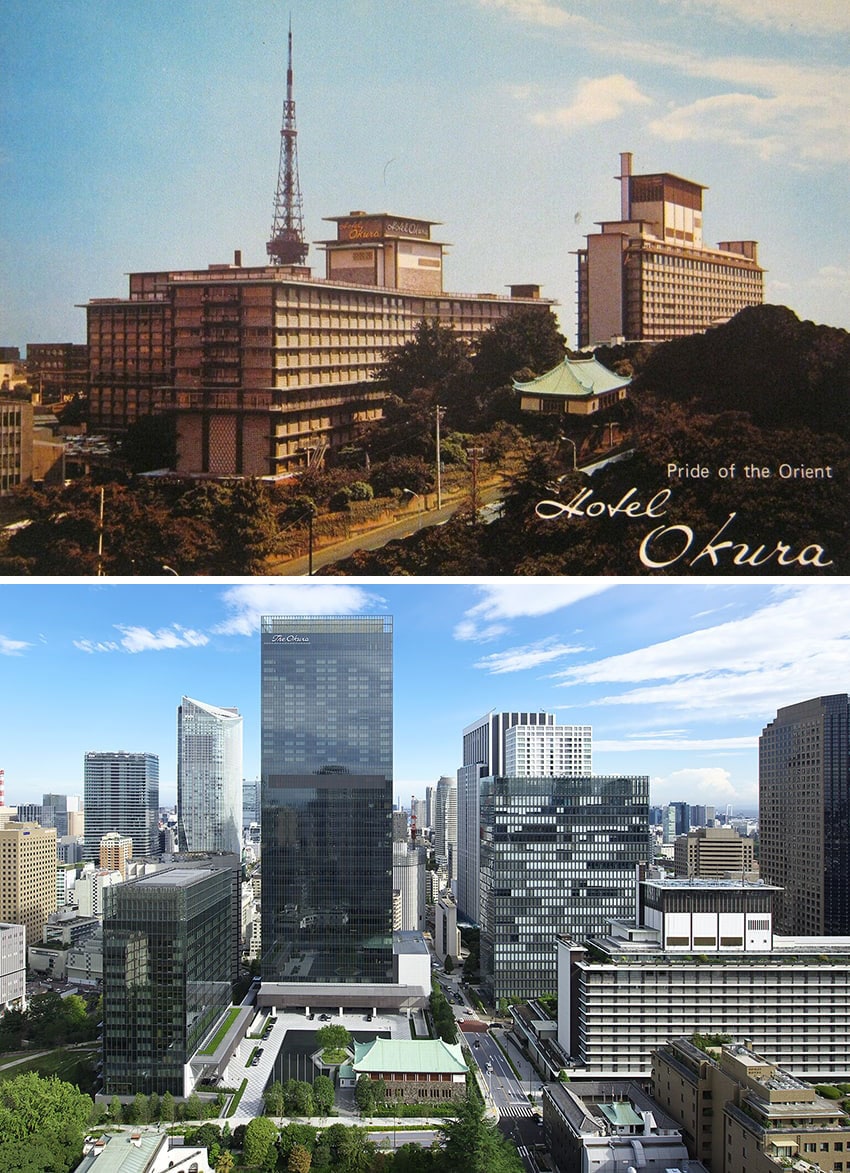 In the period photo, we can see the green roof of the Okura Museum; it serves as a landmark. The annex wing of the Hotel Okura, on the right in both photos, is also now demolished.
The Okura, with its architectural style, both exterior and interior, was a perfect reflection of its era, and as time passed, the Okura became more iconic; some would have thought it eternal.
However, to maintain its 5-star status (enlarged rooms, higher standards of amenities, etc.), to offer more beds, and, of course, to comply with increasingly stringent anti-seismic measures, it was necessary to demolish the Okura and rebuild it.

On April 25, 2014, Emperor Akihito and Empress Michiko paid a farewell visit to Barack H. Obama, while he was staying at the Hotel Okura. A sublime honor.
So, destroying the icon, where every US president since Nixon had stayed. The Okura is located directly across from the American Embassy and is so popular that it’s called “the annex.” So many other world-renowned political and artistic figures have stayed there, numerous international conferences have been held there, and even James Bond made it his residence in “You Only Live Twice.”
However, from all over the world, including in Japan, architects, historians, designers, academics, and journalists have protested against this decision, deeming it a “disastrous cultural and historical destruction”. The petitions were so numerous that the owners have reconsidered their plans. Yes, the historic hotel will indeed be destroyed (they don’t like to lose face in Japan), and yes, the entrance hall, the mezzanine, the artwork, the Orchid Bar, the light fixtures, and the famous and avant-garde (in 1962) large world map would be reintegrated into the new building.
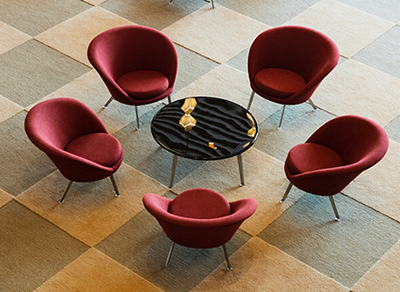
This saves the furniture, and appearances. Especially since it is Yoshio, Yoshiro Taniguchi’s son, who has been entrusted with the difficult task of “phoenixing” his father’s work, of preserving its essence, of rethinking the contemporary Okura as the old one had been, of perpetuating the icon. He is responsible for highly modern projects such as the MoMA in New York and the ultra-luxurious Ginza Six department store in Tokyo.
 The lobby, then and now, has changed little, with more elegance and light.
Taniguchi Jr. designed the new hotel as two large glass towers. One, smaller, houses The Okura Heritage, where authentic elegance and refinement are found, while the other houses The Okura Prestige, representing contemporary luxury and urbanity.
The core values that have contributed, since 1962, to making The Okura an exceptional place have been preserved and enhanced. It embodies the discreet refinement that is the essence of Japan, rather than the opulent luxury of grand Western hotels, and offers hospitality, constant and delicate attention, and impeccable service that only Japanese culture can offer. The result is remarkable, and having visited the former “Hotel Okura” and the current “The Okura Tokyo,” we can confirm that even the cozy and incomparable atmosphere of this legendary place has been preserved.
All’s well… that begins again
Brigitte & Jean Jacques Evrard
info@admirable-facades.brussels
 ADMIRABLE ARCHITECTURE - BLOG
Leave a comment